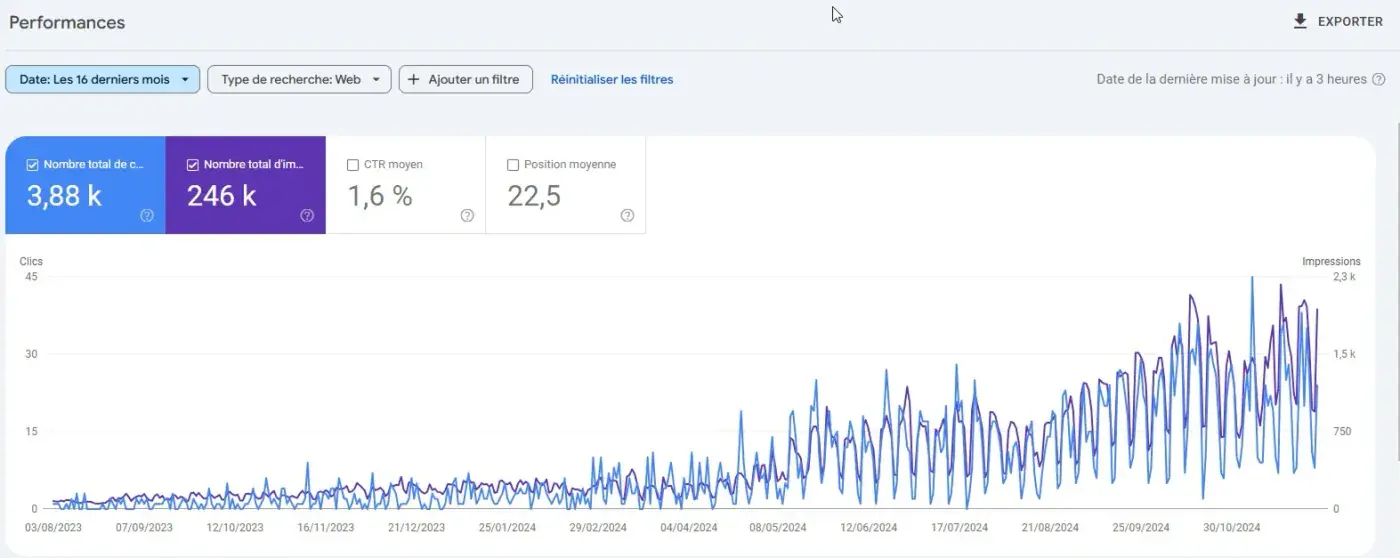
- SEO traffic within 8 months of the 2024 redesign
- ×3
- pages written and published by their team in 2026
- +325
“Honestly, you can’t find better right now. You built our whole design system and every block, and now with AI we’ve published more than 325 pages ourselves. I can confirm it really works.”
 Nicolas LeroyHead of SEO @ YoungData
Context: a website that still delivered, a message that had changed
2024, the first redesign
Elian Quesnel started YoungData as a freelancer. The business grew into an agency, and by 2024 its website no longer kept up: two separate WordPress sites, one for the agency, one for training.
We merged them into a single Webflow site. Architecture, wireframes, design, one colour per service, illustrations, then the migration with its redirects and technical SEO. Their team wrote the copy, and we trained them to run the site.
The site went live in April 2024. Within eight months, SEO traffic tripled. The team now creates new pages on its own, like its Copilot page.
“The move to Webflow proved to be a strategic decision, providing better technical performance, an improved user experience and increased SEO opportunities. With a focus on optimizing existing pages and improving CTR, Youngdata.io is well positioned to continue to grow in visibility and organic traffic.”
2026, why they came back
Two years later, the website was still delivering. But YoungData had changed.
In 2024, the site promised to “help SMEs save millions of euros thanks to powerful Microsoft tools”. In 2026, YoungData presents itself as a Microsoft Power Platform agency that builds apps, workflows and AI agents. It speaks to its clients’ business teams, not only to their IT department, and it has refocused the industries it targets.
The website had to carry this new message. It also needed more perceived value, and a fresh start in SEO to establish the new positioning on Google.
Goals: a new message, a website that carries it, a team that grows it
The website has one job: generate business, which means filling the sales team’s calendar with meetings. For this second website redesign, we set four goals with YoungData, all serving that job:
- Get the new positioning across: a Microsoft Power Platform agency, with a page for every area of expertise, every industry and every role it targets.
- Raise perceived value: a website on par with the groups that already trust them, such as Bouygues Construction, La Poste and McCain.
- Relaunch SEO and prepare for AI answers on this positioning, without losing what was gained in 2024.
- Make the team autonomous at scale: publish hundreds of pages on its own, quickly, with AI.
How we did it: from architecture to publishing rules
1. Turn the new positioning into an architecture
A new message shows first in a website’s structure. We started from what their clients search for and the roles they wanted to reach. Every visitor had to find a page about their own situation.
| Page | What it does for the visitor |
|---|---|
| Expertise (Power Apps, Power Automate, Power BI, Copilot and AI agents) | Shows what the agency builds, with examples |
| Industry | Speaks about their industry, its constraints and its tools |
| Role | Answers the problems of their job, from finance director to maintenance manager |
| City | Helps them find a Power Platform expert nearby |
| Guide | Answers a precise question in a few sentences that Google and AI tools can quote |
| Case study and training | Prove the agency has done it before, and can train their teams |
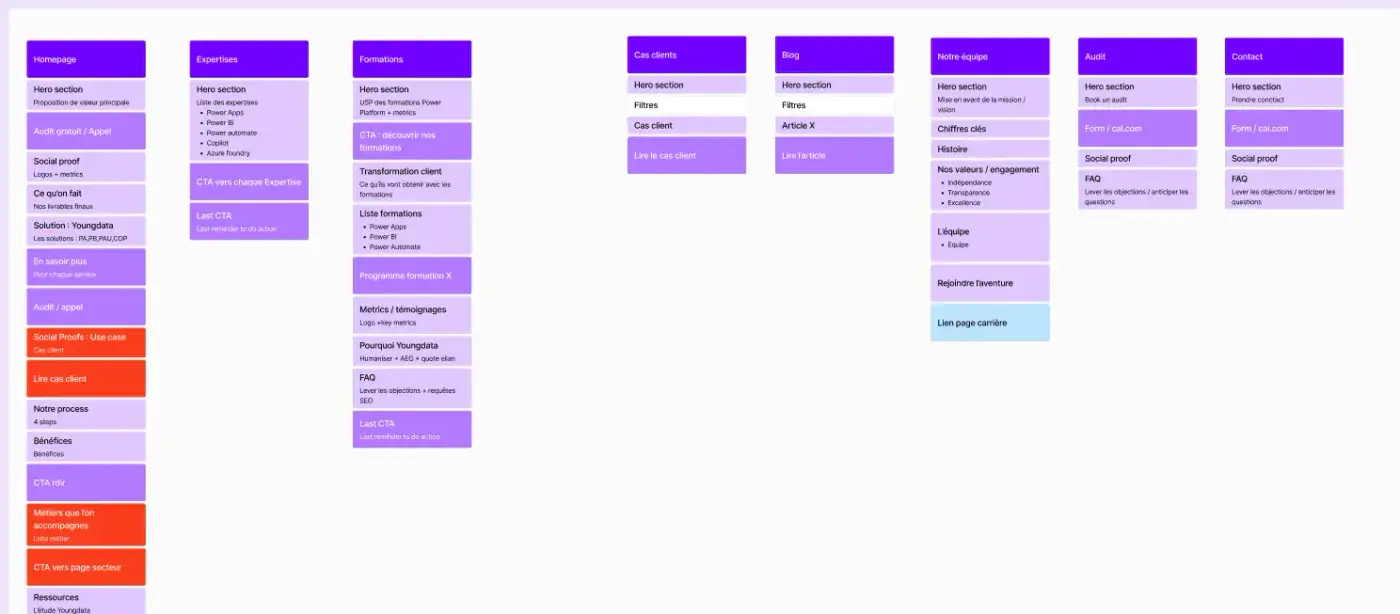
2. Wireframes built around the copy
We designed wireframes for every page type: home, expertise, industry, role, city, training, case study and menu. YoungData’s team wrote the copy from these wireframes; we reviewed and reworked it with them.
Every page gets the same conversion building blocks: a resource to download, a way to book a meeting, and a short answer at the top of the page, designed to be quoted by AI tools.
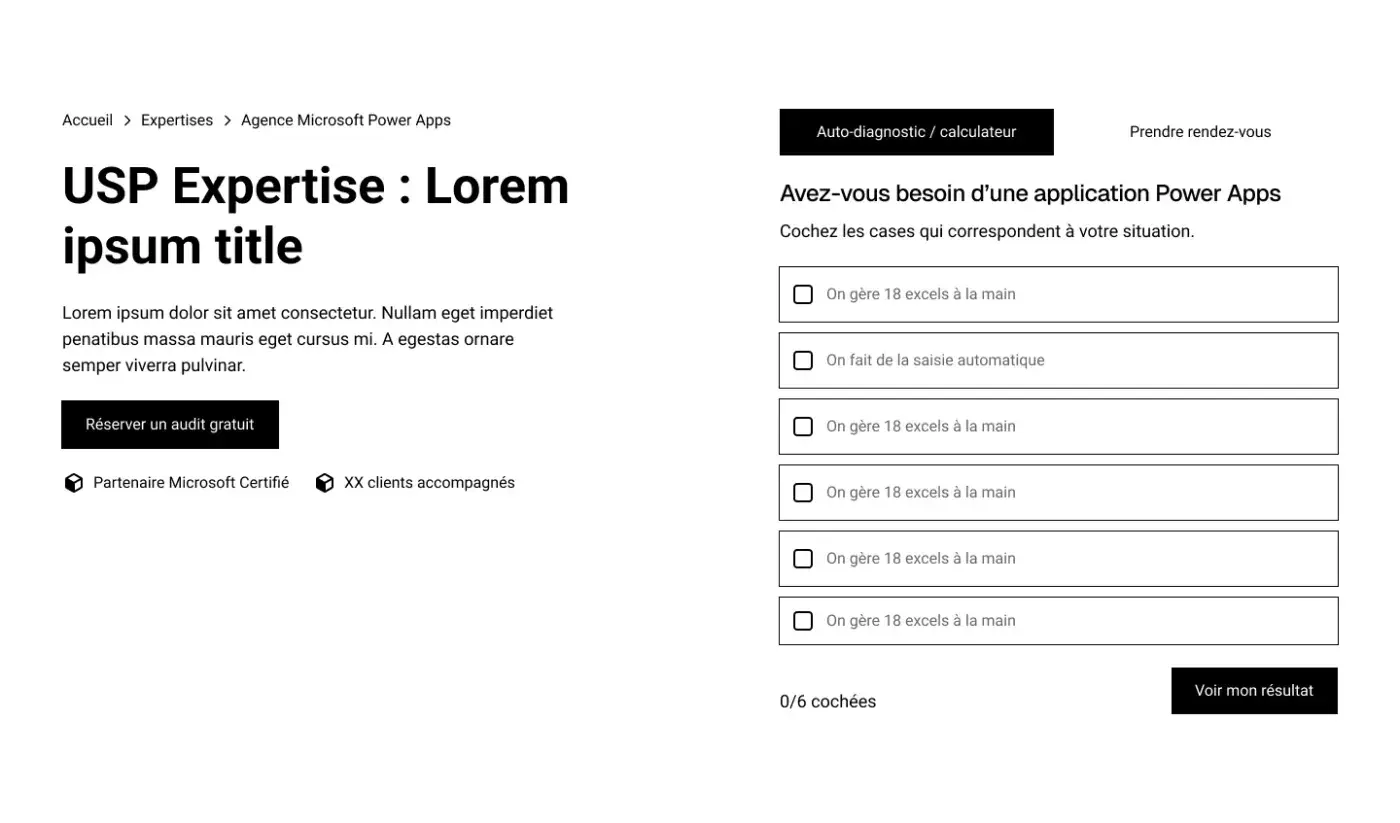
3. Find the visual tone
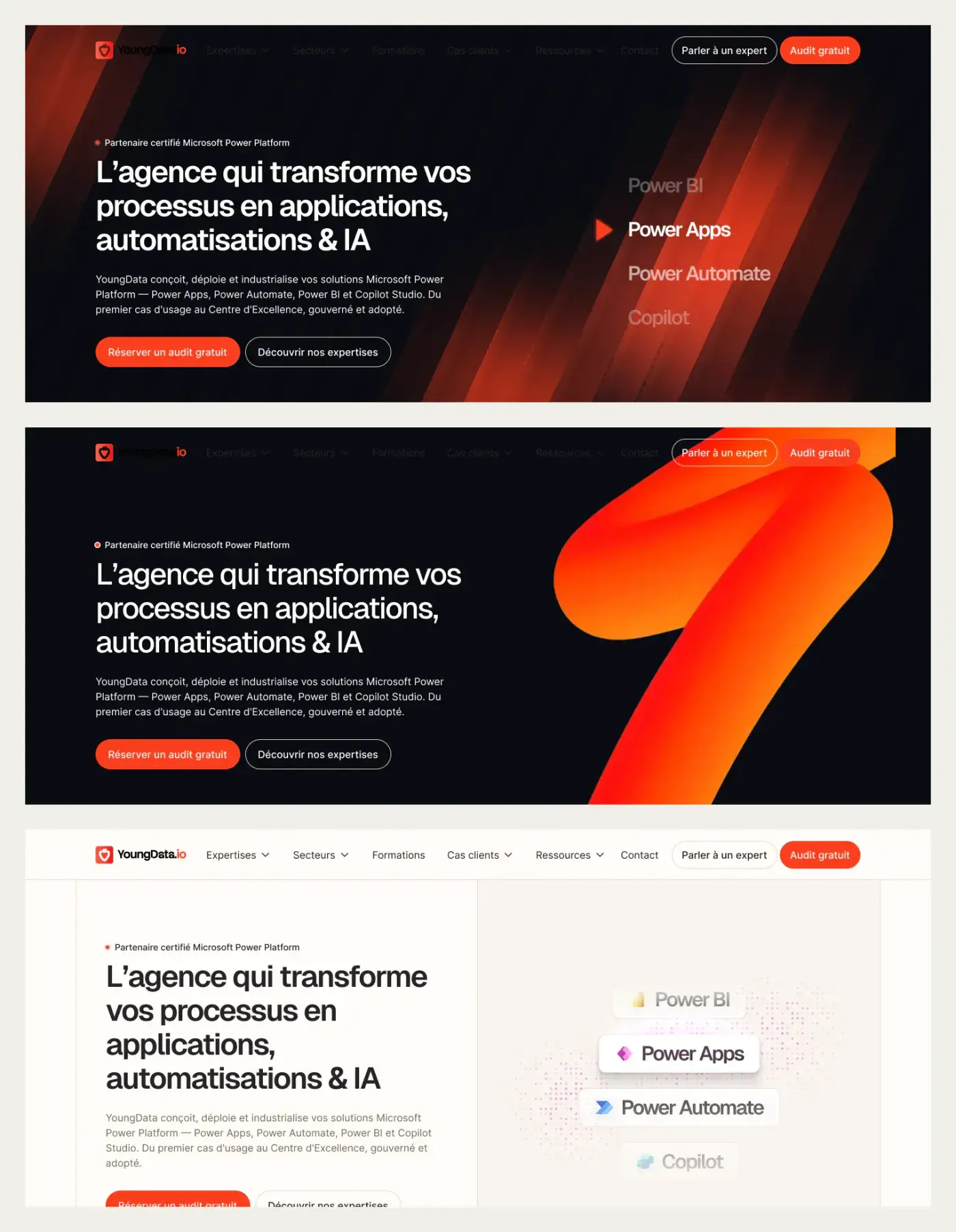
Before the mockups, we tested several directions for the homepage hero, from the most restrained to the most expressive. YoungData chose its own while keeping its logo, simply modernised. The website now speaks like an agency that works for large groups.
4. A design system and illustrations the team extends with AI
We designed and built the whole website in components: each section is a reusable block, with its variants. For the team, creating a page means assembling blocks, without breaking the design.
Thanks to this system, the team also publishes with AI: a page is built from the same blocks, by hand or with an assistant.
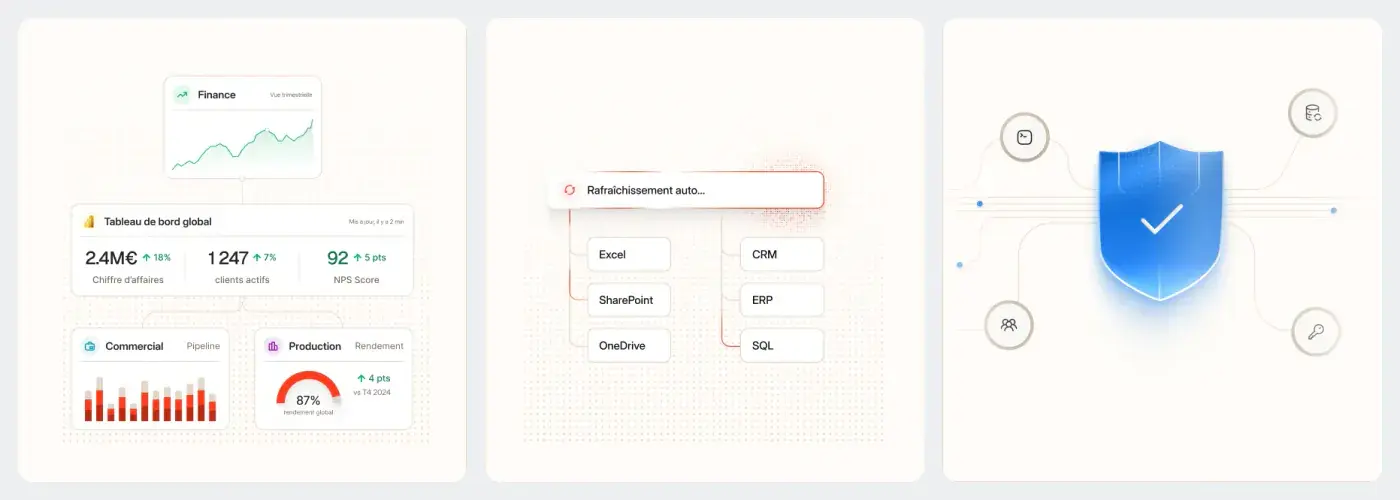
The illustrations follow the same logic. We drew the first ones by hand; to have them on hundreds of pages, YoungData’s team extended and animated them with AI, on the same model.
5. Webflow, technical SEO and lead tracking
The website is built on Webflow. The richest animated blocks are served separately, outside Webflow. Old URLs are redirected one by one to their new pages, and the key templates (guides, roles, expertise) carry their structured data for Google and AI tools.
Every request is tracked: forms, online booking, the source of each contact. YoungData knows which page brings in its meetings.
6. Rules for publishing with AI
So the team could publish on its own, we wrote its guidelines: the rules for each page type, for conversion, for Google and for AI tools, plus review and publishing. The team publishes from Claude, straight into Webflow.
The 250 guides go live in waves over a month, to keep a natural pace in Google’s eyes.
Before / after: from a website that explains tools to one that shows expertise
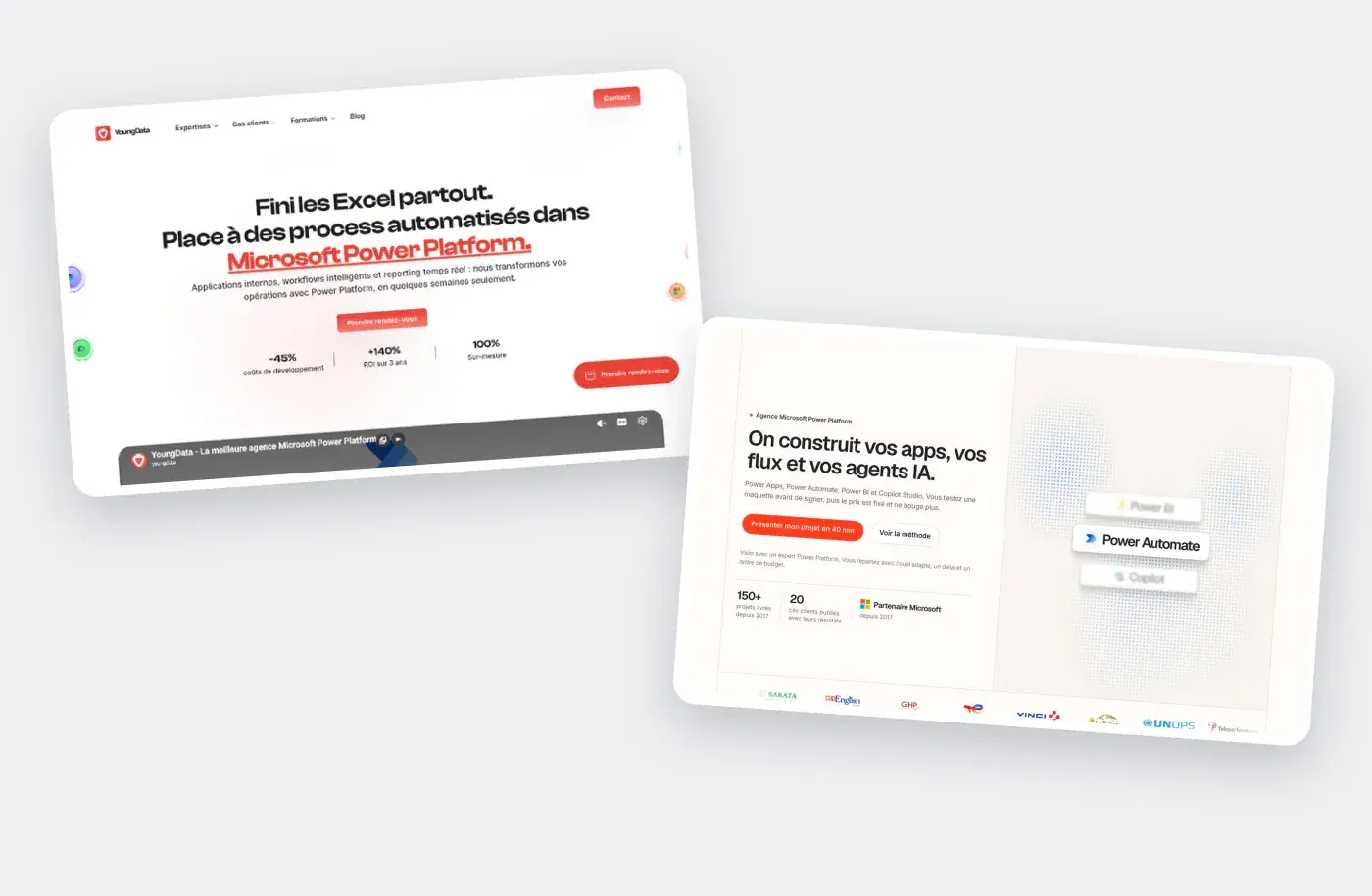
Before the 2026 redesign, the homepage promised “No more Excel everywhere” and presented the Microsoft tools. Today, it says what the agency builds: apps, workflows and AI agents. Visitors immediately see projects that look like their own.
Results: a team that publishes autonomously, a website ready for Google and AI
In 2024, SEO traffic tripled between April and December, in the eight months after launch.
In 2026, the website has been live since 6 October. The first effects:
- An autonomous team: YoungData’s team has written and published more than 325 pages itself, guides included, with our components and its guidelines.
- A fast website: the homepage scores 96/100 for mobile performance on PageSpeed Insights (measured on 1 November 2026).
- A first lead from AI: a few weeks after launch, a qualified lead in their target market, an industrial SME, came in through ChatGPT.
What’s next: an agent that answers visitors and offers a meeting
Since launch, Jenna, our AI sales agent, has been live on YoungData’s website. She answers visitors and guides them towards a meeting.
Updated on 1/11/2026